It’s important that we eat well for endometriosis. And it’s never too late to start. If you’ve already heard of the Endo Diet, you’ll know it has something to do with avoiding wheat as the main issue.
Over the last few years, there are so many people going ‘free from’ something, particularly gluten, in the belief that it is the next ‘healthy’ step to take, or are even self-diagnosing. Gluten is a protein found naturally in wheat, rye and barley, and sometimes oats due to processing methods. It never occurred to me that wheat or gluten is something ‘unhealthy’ – and it isn’t. At least not when a wheat product, such as bread, is made fresh in the traditional way with the basic ingredients – compared to many mass-produced and profitable supermarket and bakery-bought products often with added refined oils, preservatives, sugar and too much salt. Much in the same way as some gluten-free foods produced for those who need to be gluten-free, which often contain the same added nasties and now they also fly off the shelves with more people choosing to eat that way. Wheat also contains other proteins, so why have so many people assumed that it’s the gluten protein in the wheat that’s an issue for them? Could it be influenced by the low-carb or no-carb fad diets? Typically, the western diet includes a lot of wheat – so consuming less of it could be a better solution for many, rather than cutting it out. When it comes to endometriosis, it’s been suggested that it may be another protein in wheat that contributes to the inflammation. I think it’s important that I briefly make this point about gluten first.
More research now suggests that there are different people who should avoid or cut out gluten, not just those with Celiac disease. From reading around, I get the impression that this sometimes gets mispresented from both sides and creates more fear of certain foods. Meanwhile, some doctors wait for clinical studies on certain foods and their effects on different conditions, while others don’t wait years for these and instead implement dietary changes, monitor their patients and they recognise that this can be part of the treatment in conditions such as endometriosis. I’m glad I haven’t been waiting another 8 years! I’m very grateful to my consultant for his approach.
I’ve always been a strong believer of that saying: everything in moderation. Fresh is best. In my opinion, it’s all about perspective – and having a healthy vision of food.
So have you heard of the so-called Endo Diet?
It essentially revolves around avoiding too much of, or even cutting out, certain foods, such as wheat, dairy and soy, that can be inflammatory in women with endometriosis – a condition that affects 1 in 10 women. This may depend on the severity of the condition. Other inflammatory products such as too much sugar (especially added sugar) and alcohol are not particularly healthy for anyone, so removing these is already a big step in the right direction to give the body a chance to heal.
The very first thing is – discuss any dietary changes with your consultant. This is very important for medical reasons and as everyone is different – your diet should be adapted to your own needs. I would never have cut out and cut down on things in my diet if my consultant hadn’t advised me that way (apart from added sugar, of course). I’ve never followed a diet in my life. Also because – I love food, especially cheese and chocolate. A dietitian, or qualified nutritionist, can also support any changes, that are safe and sustainable, to find what works for you. This is important because a small number of people (1%) can also develop celiac disease, an autoimmune disease, which can sometimes be linked to women with endometriosis, and can then be tricky to diagnose if wheat and gluten are largely removed, and suggestive symptoms are not fully investigated by a doctor until years later.
When I was first diagnosed with endometriosis in early 2009, it was both a relief and so overwhelming to find out that there was a name for what I had been suffering for so long. One of the first things that my gynaeoclogist advised me to do was to avoid wheat. I remember thinking how on earth is this going to be possible… and why? He explained that some of his patients had shown significant improvement because they had avoided wheat, and how some managed a little of it now and again. I was really intrigued and he encouraged me to do my own research to understand endometriosis and how dietary changes can be part of the treatment. So I pursued seeing a nutritionist, too, as he suggested. I also ordered some books, and that’s when I discovered the so-called Endo diet, too.
When I started this journey, social media was still pretty new and Instagram didn’t exist. So I had to dig deep into what I could find online and in books, in terms of understanding nutrition, in addition to the endometriosis. Understanding the links between certain foods and inflammation was essential. I was studying French and German at the time in my second year at university – I might as well have been studying nutrition, but the hard work paid off. I also felt pretty alone as I didn’t know anyone else with endometriosis, and suffering so much pain was rather overwhelming. So I kept quite quiet about it, and tried to ignore the questions like ‘why do you want to eat so healthily…?’. Well, I knew I was onto a good thing, especially for myself and that was all I needed – my own motivation.
The Endo diet for endometriosis is far from a diet but rather encompasses the real meaning of the term ‘diet’, i.e. what you eat day to day. That’s because the foundation of the Endo diet is essentially a healthy, balanced diet full of wholefoods, going back to basics by preparing everything fresh without all the added nasties and processed food. It made perfect sense to me because what we may see advertised as ‘fresh’ food in a supermarket may actually not be so fresh at all, and has several hidden ingredients which can only be found if we read the ingredient labels – which most of us wouldn’t usually do. In addition to this, it involves cutting down on, and possibly fully cutting out, the wheat and dairy. We typically eat too much of these anyway, so a more realistic amount, and organic, is ideal. Added sugar is one that anyone can cut out, and is inflammatory for anyone. So I stopped buying packaged food like soups, tortellini and spring rolls – and I started to teach myself to cook, without the wheat. At first I reduced this to 50% and focused on wholegrain wheat as much as possible, and I tried to source goat’s and sheep’s milk products as much as possible. I was also advised to eat Alaskan salmon, which I sourced from Tesco. The lack of availability and higher price of wheat free and dairy free options like quinoa, buckwheat, rice pasta and even brown rice, made it more difficult to follow. Foods like sweet potato, kale and blueberries, for example, were not regularly stocked either until just five years ago. So eating this way now is technically much easier! I had a head start following the endo diet as I already cooked many things from fresh, but I had an emphasis on certain foods, often those known to be inflammatory for endo.
In those three years after diagnosis, the endo pain had already become chronic. I knew that wheat affected me a lot from my immediate symptoms, so I had to do more. From January 2012, I put the full plan into action. After completing the first semester of my final year, I went full on with completely removing the wheat for the first 6 months, reduced the dairy right down to Greek yoghurt, goat’s cheese and feta, and I cut out the added sugar (no chocolate either). I had never been interested in soy products and I knew I had a risk of hypothyroidism (the irony is this was already untreated), so this one was easy to avoid when cooking from scratch. The one thing that did remain was red meat with 2-3 portions per week, for the next 18 months. (After the initial 6 months, I ate something wheat-based about every 2-3 weeks when eating out with friends or travelling, and I found this manageable). I had written down a list of what I could eat, most importantly, not just what I could not eat to reduce the inflammation caused by endometriosis. I also started a third course of supplements that basically eradicated the Candida issue that often comes hand in hand with endometriosis – this was all supported by my consultant gynaecologist and a qualified nutritionist (who I found much more helpful than the NHS dietitian I saw). The focus on this way of eating started with the gut health and what is now known as ‘leaky gut’.
When you make this switch, it’s not an overnight miracle worker – and you have to understand the effects that these changes have, and therefore why you can feel a bit worse at first. This is why gynaecologists and dietitians/qualified nutritionists are excellent sources of information and support. I started to notice changes after 5 days and then 5 weeks. My pain levels decreased up until my excision surgery in March 2012, and my brain fog lifted – which really helped with my final degree exams fast approaching!
I essentially followed the Paleo diet for the two months, although with Greek yoghurt each day and sometimes brown rice. I didn’t know at the time that that was what it was called 😀 as it wasn’t ‘trendy’. But it worked for me. And therefore, my opinion of the Paleo diet is that this is useful in the short term, maybe longer, also because it focuses on foods like vegetables, white meat, eggs and fish, which we are often used to eating, are nutrient dense, and bring the blood sugar under control. So this helps to get started eating a healthy, balanced diet. The main aim was to target my gut health. I also switched to organic products as much as possible, though mainly the animal products, which were becoming more readily available at that point. I ate plenty of vegetables and salad (even a little with breakfast), and also I included potatoes, both white and sweet potato (which was only just becoming ‘trendy’ and more readily available). The Paleo diet also includes nuts and seeds which naturally have amazing health benefits.
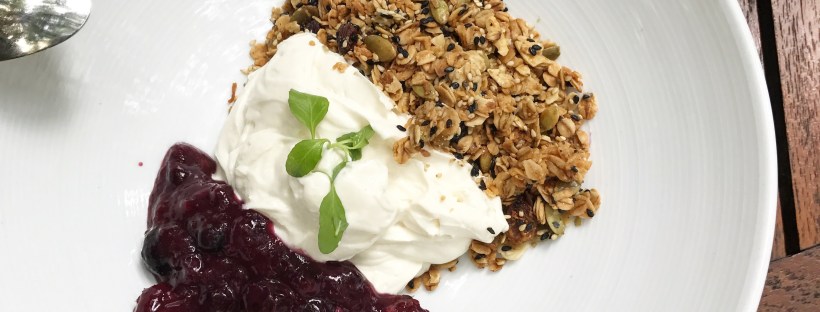
Actually my breakfast was really boring in the first couple of weeks – gluten-free corn flakes or the gluten-free oat granola from Sainsbury’s as they had just 2g sugar/100g, but with some Greek yoghurt, cinnamon and blueberries which livened it up. This is where my breakfasts began and evolved to much more which can be seen in my Instagram pictures.
I should also note – I looked into how female body builders eat following glandular fever in December 2009. This was because it left me with what seemed like some muscle wasting and so had a greater impact on managing the endometriosis and recovery – and at that point, the undiagnosed Hashimoto’s thyroiditis. It took a while to gain muscle again that stayed around, about three years, and I wanted to be strong again – I’ve always been into sports and so was not afraid of lifting weights. That’s when I discovered the ‘clean eating’ way of eating and I understood this to simply be a healthy, balanced diet, full of fresh wholefoods, which I’ve emphasized before. Meal prepping also helped to stick to eating well, especially with a busy schedule. Since then, the clean eating trend has really taken off, albeit with varying, and sometimes worrying, interpretations.
As I did all of this before the rise of Instagram and many ‘trends’ in food and fitness, it’s been interesting to see how they have developed – as well as the rise of food bloggers, the interpretation of different foods that are seen as or labelled healthy/good or unhealthy/bad, people jumping on the bandwagon with gluten-free/dishing out unqualified advice on exact diets or incorrect/false information, and people rushing into studying nutrition. It was like: woah, slow down 😀 I am happy that the advice I was given revolving around gut health, is now a major area of research. This is great news for medicine and nutrition, particularly in the management of chronic illness.
Seeing a food as ‘healthy’ or ‘unhealthy’ has become a mine field. It can also aggravate the views that some people, especially women, have of certain foods and dieting. This is why whether we call it the ‘Endo Diet’ or not, healthy eating needs the right perspective and the understanding that it is in no way a diet ‘to lose weight’, although that can be achieved depending on your prior eating habits and portion size. It could also be that women, who are previously underweight, can then achieve a healthy weight. I personally like to call it the Endo Diet, too, as we are able to relate as women with endometriosis to how we can eat well for it and adapt it to our own needs. I am not a professional, but it seems very clear to me that eating a normal healthy diet will certainly help achieve this by starting to eat right, which is what the endo diet effectively is, while taking into account the intake of wheat, soy and dairy.
In my experience, through school, uni and work, I keep coming across women who say ‘I need to go on a diet’ – it’s like hearing it on repeat. They think they need to lose weight when quite often they don’t need to, or they keep dieting by living off salads or missing meals, even starting the day with a chocolate muffin and coffee, for example… and then saying the same thing, which brings about feelings of guilt and resentfulness – and then going back to how they eat – which is clearly not sustainable and just drives a negative outlook of food. I’ve included this experience I’ve had because this emphasises the importance of how we look at food, how we are influenced by others especially from magazines (as it used to be) and social media more than ever, and involving medical professionals when changing our diets – whether our aim is to treat and manage a medical condition, or to lose weight, and sometimes both.
To end part 1, I would emphasise the importance of movement and exercise as part of eating well – any form of movement is a great start, walking is amazing, not to mention the fresh air, sunshine and drinking more water to quench your thirst. Obviously I’m no expert in fitness, but I have always been active and I love sport. While my level of exercise dipped at the strongest points of my endo pain in earlier days, I pushed through when I could as I realised the benefits. I was into athletics and ballet at school. Then I got into skiing and then ski racing at uni. I’ve also been a gym goer from starting uni, three times per week, and I was always keen to ask the fitness instructors for advice and targeted exercises. I’m always keen to eat right through the day, I eat a bit extra on gym days to prepare myself well and I eat a balanced meal after the gym. I’ve just realized I haven’t even mentioned calories!! But you know why? Because I’ve never cared for them. To me, in a nut shell, calories are energy and as long as we eat well and the right portion size, and stay active, we will be achieving the recommended calorie intake. I never work out in the mornings before breakfast – this is a personal one, as it also depends on health conditions that have nothing to do with being motivated to workout at 6/7am or earlier. I listen to my body, weigh up the pros and cons of everything and I listen to medical advice.
Look at the positives in food, stay active as much as you can and you’ll be on the right track 🙂 ❤
Part 2 will follow, which will be about the foods to eat and to avoid when eating well for endometriosis, and what I eat myself following an adapted Endo Diet.
Kate xx
 NaturallyIndulgent by Kate